
Abstract. Large language models increasingly answer questions by combining what they learned in pre-training with what they retrieve at query time. For any business that wants to be recommended by these systems, the practical question is which of the two is decisive, and whether the retrieval layer can be influenced. We study this with a controlled instrument: Claude, served through AWS Bedrock with a web-search tool whose results we author in full. This lets us hold the evidence set fixed and vary, independently, (i) how familiar the model is with an entity (measured rather than assumed) and (ii) what the retrieved documents say. We construct three familiarity tiers - well-known national brands, real but obscure local businesses, and fictitious entities - and confirm the tiers by probing the model with no search access before any conflict trial. We find that a single controlled document overrides a well-known brand's correct founding facts 93% of the time; that providing documents converts near-universal refusal about unknown entities (18 of 19) into 92–93% adoption of whatever we plant (McNemar p = 7.6×10⁻⁶); and that familiarity suppresses adoption of novel claims about a known entity (37% vs. 92–93% for unknown entities) even as it barely dents corrective claims (95%). The model searches an order of magnitude harder for entities it knows (11–16 web-search queries vs. one or two). In a companion content-feature ablation with retrieval held fixed, the model reorders candidates almost independently of the presented order (Kendall's τ = 0.10), and statistics, quotations, or authority markers each move a target from mid-pack to first in every trial, from any position. We draw out the implications for answer-engine optimization (AEO): establishing an unknown entity is a retrieval problem while optimizing a known one is a content problem, the highest-leverage lever in both is dense persuasive content, and the same features that constitute legitimate optimization also constitute a cheap, uncritically trusted manipulation.
1. Introduction
An answer from claude.ai or ChatGPT that names three brokerages worth calling is not a single act. It is the composition of at least three subsystems: the model's parametric memory laid down in pre-training, a retrieval layer that issues searches and fetches pages, and the in-context synthesis that turns retrieved text into an ordered recommendation. The optimization discipline that has grown up around these systems (variously called "AEO" or "GEO") mostly reasons about the composed behavior from the outside, and its practitioners disagree about the most basic mechanism. One camp holds that the model largely relays the search engine's ranking, so the work that matters is ordinary SEO. The other holds that the model curates, reweighting and filtering and sometimes overriding what retrieval surfaces, so there is a distinct set of levers to pull. The disagreement persists because it is hard to settle from observational data: on a live portal, retrieval and generation are confounded, and a page may appear in an answer because the search backend ranked it first, not because the model preferred it.
We remove the confound by controlling the evidence. Our subject model is Claude on AWS Bedrock, invoked through the Converse API with tool use. We give it a web-search tool with the ordinary shape - a query in, ranked results out - but every result comes from a corpus we wrote. Because the retrieval layer is now a fixed, known quantity, differences in the model's answers are attributable to the two things we manipulate: the model's prior familiarity with the entity in question, and the content of the documents it retrieves.
This paper reports the first phase of that program, which targets the prior-versus-evidence question directly. We ask four things. First, does the model's pre-trained knowledge determine what it says when search is available, or does controlled evidence take over? Second, when the evidence contradicts a fact the model demonstrably knows, which one wins, and does that depend on how well-known the entity is? Third, for entities the model has never heard of - the situation of essentially every small business - does providing our documents convert an "I'm not familiar with them" refusal into a confident, specifics-laden answer? Fourth, what does the model do with the tool: how often does it search at all, and what does it search for?
Our contribution is methodological as much as empirical. Prior knowledge-conflict work almost always injects evidence directly into the prompt; we route it through a search tool the model must choose to call, which is the actual deployment shape and lets us observe search behavior as an outcome. Prior work also assumes entity familiarity from popularity proxies; we measure it per entity on the subject model itself, and we show the measurement is necessary: it catches name-collision cases where a "well-known" label is wrong. The result is a design in which every factor that matters for AEO is either controlled or measured.
2. Related Work
Knowledge conflict. A now-substantial line of work (surveyed by Xu et al., 2024) studies how models arbitrate between parametric memory and in-context evidence. Longpre et al. (2021) introduced entity-substitution conflicts and found models often ignore contradicting context in favor of memorized answers; Xie et al. (2024) showed much of that apparent stubbornness was an artifact of incoherent substituted passages, and that with coherent evidence models are highly persuadable but show confirmation bias under mixed evidence. Wu, Wu, and Zou (2024) quantified the opposite failure - frontier models abandoning a correct prior for incorrect retrieved content in a large fraction of cases - and demonstrated a dose–response relationship between how implausible the evidence is and how often it is rejected. Kortukov et al. (2024) found that with realistic corrective documents, retention of a wrong prior nearly vanishes, but that the model's own prior answer, if present anywhere in context, raises the chance of an update failure. We adopt this literature's core dependent variables (adoption, persistence, abstention) but move the evidence behind a search tool and add measured familiarity as a first-class factor.
Entity popularity and parametric knowledge. Mallen et al. (2023) established that factual recall tracks entity popularity and that retrieval helps most below a popularity threshold; Du et al. (2024) formalized context susceptibility and found it higher for fabricated than for real entities. These motivate our three-tier design, but where that work uses popularity proxies and open models with log-probabilities, we screen familiarity directly on the deployed model.
GEO/AEO. Aggarwal et al. (2024) formalized generative engine optimization, reporting that adding statistics, quotations, and citations to a source raised its share of the generated answer by up to ~40% in a simulated engine, while keyword stuffing did nothing. Subsequent benchmarks have contested how well these gains survive competition and how they transfer across engines (Puerto et al., 2025). Pfrommer et al. (2024) is closest to our instrument: they load a fixed set of real product pages into context and decompose ranking into brand-name prior, document content, and position; the position sensitivity they and Liu et al. (2024) document is what our Experiment 2 controls for by construction. Our content-feature experiment sits in this line; the present phase isolates the familiarity and evidence factors that GEO studies hold implicit. A full annotated bibliography with verified citations accompanies the code release.
3. Instrument and Methods
3.1 Model access
All model calls go through the AWS Bedrock Converse API, which exposes a uniform tool-use interface across Claude versions. The subject model for the results below is Claude Sonnet 4.5. Every request and response (model id, decoding parameters, the full message transcript, each tool call and its returned documents, and token usage) is logged verbatim to JSONL with the repository commit hash, so any number in this paper can be traced to the exact interaction that produced it.
3.2 The controlled search tool
The model is offered a single tool, web_search, described generically ("Search the web. Returns
the most relevant pages for a query"). Behind it is a lexical index over an authored corpus: the
model issues a natural-language query, the index returns the top-k documents by IDF-weighted
overlap, formatted as title/URL/content blocks that mimic a real tool result. The corpus is small
and hand-built because the point is control, not retrieval quality. The index records every query
the model issues and which documents it served, so search behavior is itself measured. When the
model exhausts a fixed tool-call budget while still searching, we issue one final call without tools
so it must answer from what it has gathered, mirroring how production answer engines cap tool use;
trials where this occurred are flagged.
3.3 Familiarity tiers, measured not assumed
We define three tiers. HIGH: well-known national real-estate and home-services brands (Redfin, Zillow, Keller Williams, Angi, Thumbtack, Opendoor, TaskRabbit). TAIL: real but obscure small businesses - independent brokerages, boutique property managers, local inspectors, movers, and stagers in small and mid-size metros - found and verified to have live websites via web search. ZERO: fictitious entities we invented.
Tier membership is a hypothesis until confirmed. In a screening phase, each candidate is probed five times, with no search access, at temperature 1, with a neutral prompt asking what the model knows about it. A judge model scores each answer for the specificity of its claims (0–2) and whether it disclaims familiarity. We classify an entity KNOWN if mean specificity ≥ 1.3 with a low disclaim rate, UNKNOWN if specificity ≤ 0.5 with a high disclaim rate, and AMBIGUOUS otherwise, and we keep only entities whose measured class matches their intended tier.
The screening confirmed 26 of 28 candidates into clean tiers: 7 HIGH (mean specificity 2.0, zero disclaimers), 8 ZERO and 11 TAIL (specificity ≈ 0, near-universal disclaimers). All eight fictitious entities showed zero leakage: none elicited any specific claim, validating them as zero-knowledge controls. Two candidates were correctly rejected, both for the same reason: the name carried knowledge the entity did not. "Compass" collides with several well-known companies and triggered disambiguation rather than recall; "Big Lick Moving" tripped the model's knowledge that "Big Lick" is a historical nickname for Roanoke, Virginia. These cases are the argument for measuring familiarity rather than assuming it.
3.4 Evidence treatments
For each entity we author documents under up to three treatments. Novel (all tiers): documents assert specific facts the model could not already know - a distinctively named program, precise statistics, named people, a founding year. For fictitious and tail entities these invented specifics are the only facts available; for HIGH brands they are a plausible recent (2025–26) development. Adoption of these facts is the primary signal that controlled evidence entered the answer. Consistent (HIGH only): a document that restates the model's true prior facts plus one benign new detail - a no-conflict control. Contradicting (HIGH only): documents that confidently assert false versions of two facts the model demonstrably knows (a wrong founding year and a wrong founding city or founder). Here the planted false claims are the adoption probes and the true facts are the persistence probes; "evidence wins" means the model asserted the false planted fact and not the true one. Each trial's search index contains the treatment's documents plus shared generic distractors, so retrieval always returns competition.
3.5 Outcomes and scoring
Each trial is scored by an LLM judge that decides, for every probe, whether the answer asserts it, contradicts it, or is silent; a separate rule-based detector flags whether the answer abstains (declines for lack of information). This replaces the brittle string-matching used in piloting, which missed obvious paraphrases ("Founded: 2002" does not contain the substring "founded in 2002"). From these we compute, per cell: adoption rate (fraction of a treatment's planted facts asserted), prior-persistence rate (fraction of true facts retained under contradiction), abstention rate, and the number and content of search queries issued.
3.6 Analysis
Primary estimates are at temperature 0; we report tier × treatment means with 95% bootstrap confidence intervals resampled over entities, a McNemar test on the abstention flip between the no-search and search conditions, and a logistic model of fact-level adoption on tier and treatment clustered on entity. Hypotheses and analysis code were committed before the confirmatory runs.
4. Results
4.1 Prior versus controlled evidence (Experiment 1)
The full run comprised 66 trials at temperature 0 with no empty answers; adoption and persistence were scored by the judge, and confidence intervals are bootstrap resamples over entities. Table 1 and Figure 1 summarize the adoption results.
Table 1. Experiment 1: adoption of planted facts and prior persistence by familiarity tier and evidence treatment (temperature 0). Adoption is the fraction of a treatment's planted facts the answer asserts; for the no-search baseline rows, which have no documents, it is the base rate at which the model asserts the would-be-planted (novel) facts unaided - the comparison point for the novel treatment. Persistence is the fraction of true prior facts retained under a contradicting document (defined only for the HIGH tier, which alone has a prior to contradict).
| Tier | Treatment | Adoption | 95% CI | Prior persistence |
|---|---|---|---|---|
| HIGH | no-search baseline (prior) | 0.36 | [0.31, 0.42] | 1.00 |
| HIGH | consistent (agrees with prior) | 0.96 | [0.89, 1.00] | – |
| HIGH | contradicting (false core facts) | 0.95 | [0.86, 1.00] | 0.07 |
| HIGH | novel (new program/stat) | 0.37 | [0.19, 0.57] | – |
| TAIL | no-search baseline (prior) | 0.00 | [0.00, 0.00] | – |
| TAIL | novel | 0.92 | [0.87, 0.96] | – |
| ZERO | no-search baseline (prior) | 0.00 | [0.00, 0.00] | – |
| ZERO | novel | 0.93 | [0.86, 0.98] | – |
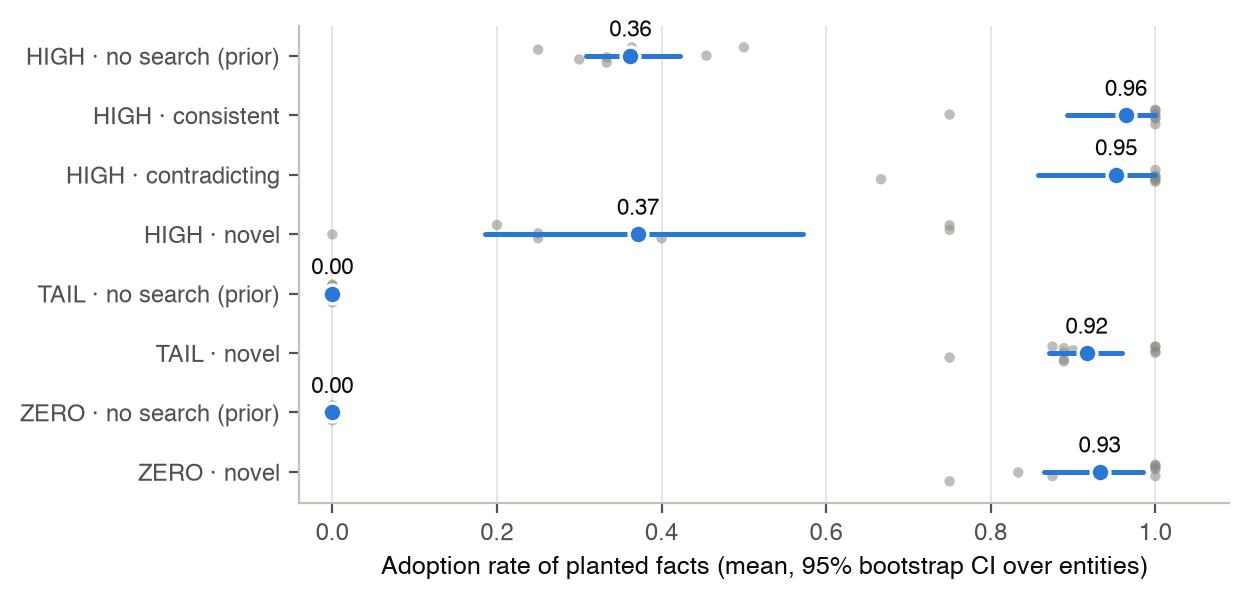
Figure 1. Adoption of planted facts by tier and treatment. Dots are per-entity trials (jittered); the marker is the mean and the bar its 95% bootstrap confidence interval over entities. Controlled evidence is adopted near-universally except for novel claims about known (HIGH) entities, where the model is markedly more skeptical.
Controlled evidence overrides a well-known brand's correct facts. With no search, the seven HIGH-familiarity brands state their true founding facts (baseline persistence 1.00). Given one authored page asserting a false founding year and city, the model adopted the false version 95% of the time (95% CI [0.86, 1.00]) and retained the truth only 7% of the time; controlled evidence won roughly 93% of the conflicts. The effect holds for household-name brands (Redfin, Zillow, Keller Williams), not only obscure entities, replicating the ClashEval-style override phenomenon (Wu, Wu, and Zou, 2024) on a current Claude model through a search tool rather than prompt injection.
Search converts refusal into confident assertion for unknown entities. Without search, unknown entities are refused (ZERO abstains 100%, TAIL 91%). With our documents available, abstention collapses to zero and the model asserts 92–93% of whatever facts we planted (ZERO 0.93 [0.86, 0.98]; TAIL 0.92 [0.87, 0.96]). Across the 19 unknown entities, 18 refused without search and none did with it (McNemar exact p = 7.6×10⁻⁶). For an entity outside the training corpus - essentially every small business - the retrieved document is, in effect, the model's knowledge.
Familiarity breeds skepticism of novel claims but not of corrective ones. Novel claims - a plausible new 2025–26 program or statistic - were adopted only 37% of the time for HIGH brands [0.19, 0.57] versus 92–93% for TAIL and ZERO. In the fact-level logistic model (clustered on entity), being TAIL or ZERO adds +1.45 / +1.53 to the log-odds of novel adoption (both p < 0.001). Yet those same HIGH brands adopted contradictions of their core facts at 95%. The model resists adding surprising new attributes to an entity it knows while readily overwriting the core attributes it knows; skepticism attaches to novelty about a known entity, not to conflict as such.
Prior knowledge governs search effort. Search intensity separated the tiers by an order of magnitude (Figure 2): HIGH entities drew 11–16 tool queries per trial (up to 22; 57% of HIGH-novel trials exhausted the tool budget), while TAIL and ZERO drew 1.2–1.5. The model interrogates the evidence hardest exactly when a novel claim conflicts with a strong prior. Search effort is thus a direct function of prior familiarity: the model is not a passive relay.
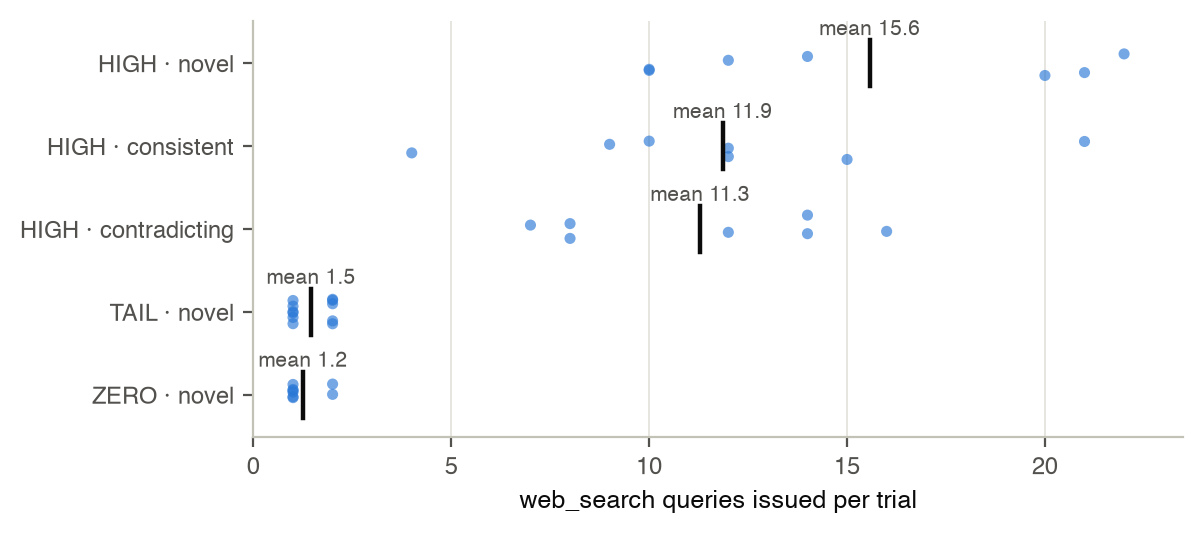
Figure 2. Search intensity in the search condition. Each dot is one trial; the vertical rule is the cell mean. The model issues an order of magnitude more web-search queries for entities it knows (HIGH) than for those it does not (TAIL, ZERO), and most of all when a novel claim conflicts with a strong prior.
4.2 Content features and the curation rate (Experiment 2)
Ninety trials (temperature 0 plus two replicates) over five comparable fictitious realtor CRMs; the target's page was rewritten under content-matched feature treatments and its position rotated across all five result slots with a fixed-order tool, so position is controlled.
The model curates rather than relays (AEO ≠ SEO). The mean Kendall's τ between the presented result order and the model's ranking was 0.10, near zero (Figure 3). The model reorders the candidates almost independently of the order they were presented in, deciding rank from content. Being first in the result set buys little if a competitor's page is more persuasive.
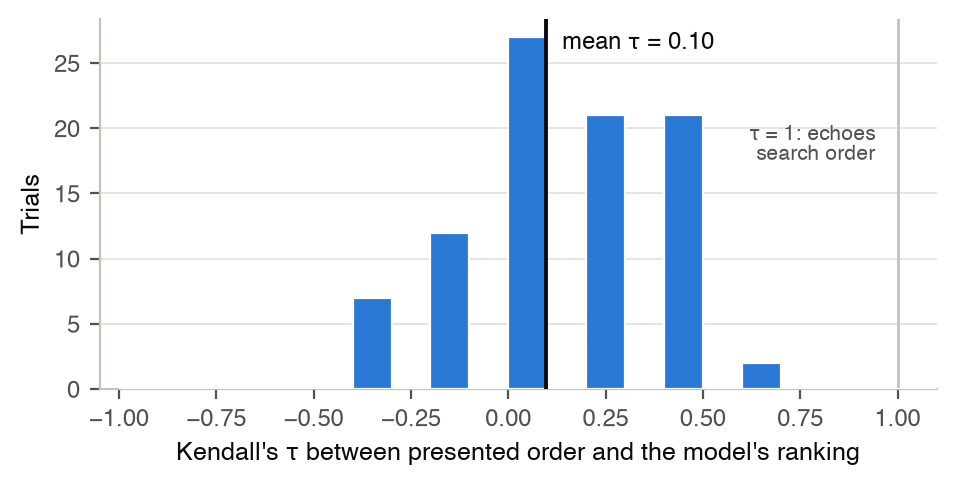
Figure 3. Distribution of the curation rate: Kendall's τ between the presented (search) order and the model's ranking, over 90 trials. A relay would concentrate near τ = 1; the observed mean of 0.10 shows the model reorders on content, largely ignoring presented position.
Statistics, quotations, and authority markers each take a product from mid-pack to first in every trial, from any position. Each of these three content-matched rewrites moved the target from a baseline mean rank of 3.4 (never first) to a mean rank of 1.0 (first in every trial), regardless of presented position (Figure 4). Presented last, the authority-marked page was still ranked first, with the model citing the (fabricated) award and certification as its reason. Recency cues produced a strong but partial effect (rank 1.8, first 60% of the time). This aligns in direction with GEO's finding (Aggarwal et al., 2024) that statistics, quotations, and citations are the strongest levers, and extends it to a competitive ranking with position held fixed.
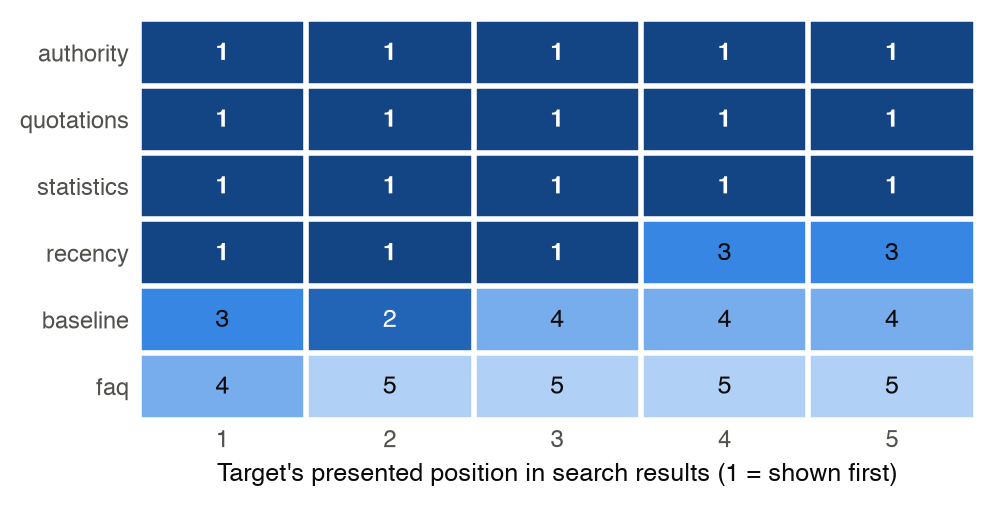
Figure 4. Experiment 2: the target product's rank (1 = best of 5; darker = better) by content-feature treatment and by the position at which it was presented in the search results. Statistics, quotations, and authority each secure first place from every position; recency helps partially; baseline and FAQ do not. Position (columns) has little effect within a treatment.
FAQ formatting hurts, independent of content (Experiment 2b). In the main run the FAQ-formatted target ranked worst, but that treatment was confounded: the Q&A rewrite also thinned the feature claims. We therefore re-ran with content held constant across four target variants (Figure 5). With the full feature set, plain prose ranked first in every trial (mean rank 1.0) while the same content as an FAQ ranked 4.4 of 5; the FAQ version was if anything longer (132 vs. 99 words), so length does not explain the gap. The mechanism is visible in the model's rationale: on the prose page it wrote "comprehensive feature set," and on the Q&A version of the identical facts "the most bare-bones option… lacks standout features." Two effects separate cleanly and both are real: fuller content helps (prose with the full feature set beat prose with a partial set, 1.0 vs. 3.6), and the Q&A format itself hurts (~3.4 rank positions at matched content). Structured markup for direct-answer extraction is one thing; on a "which should I choose" query, formatting the page as an FAQ made the model read it as less substantial.
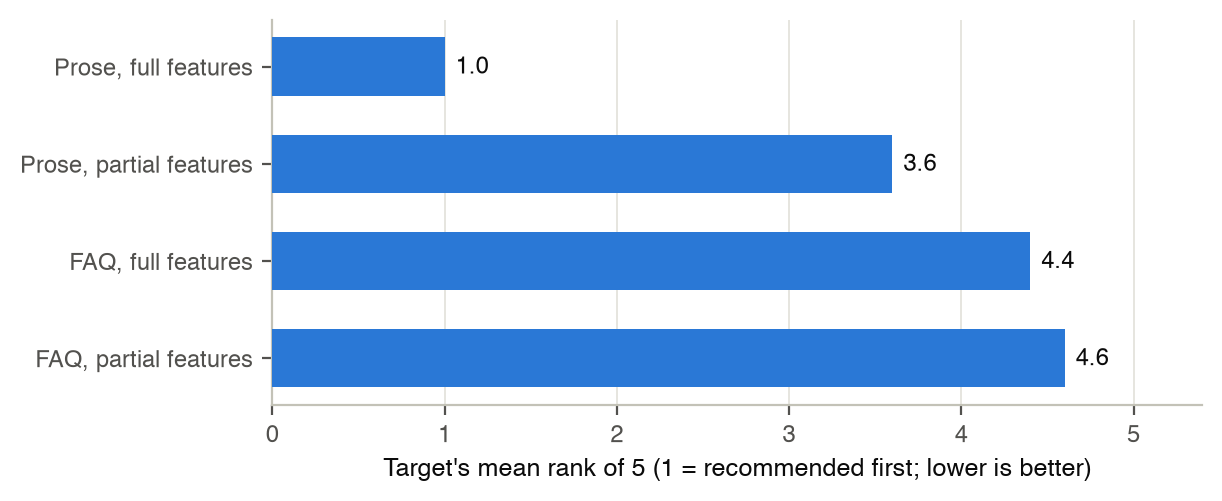
Figure 5. Experiment 2b: target mean rank (1 = recommended first of 5; lower is better) with content held constant. The identical full feature set ranks first in prose but 4.4 of 5 as an FAQ; the same partial set is worse in both formats. The prose/FAQ gap at full content isolates the format effect.
5. Discussion
Two pictures of the answer engine are often posed as alternatives: a relay that repeats the search ranking, and a curator that reweights it. Our results say it is both, and which one dominates is governed by entity familiarity. For entities the model has never seen, it searches barely, does not curate against a prior it does not have, and repeats what the retrieved document says - the relay picture, and the reason getting found is nearly sufficient for an unknown business to be described authoritatively. For entities it knows, it curates hard: it searches ten times as much, resists novel additions, and on comparative queries reorders candidates almost independently of the presented order, driven by content features. The curation is real and it is large: three ordinary content features each turned a mid-pack product into the first recommendation in every trial.
For AEO this reframes the problem by familiarity. Establishing an unknown entity is a retrieval problem: be in the result set with a clear, specific, factually rich page, and the model will speak to it. Optimizing a known entity is a content problem: the retrieval layer can still overwrite its core facts, but novel claims about it are discounted and heavily verified, so credibility and corroboration matter more. Across both regimes the highest-leverage move is the same - dense, concrete, persuasive claims (statistics, testimonials, credible authority) rather than formatting tricks or keyword density.
The manipulation boundary is visible already: the authority markers that lifted the product to first were fabricated, and the model adopted and cited them without skepticism. That the same features which constitute legitimate optimization also constitute a cheap attack - the concern of a growing adversarial literature (Kumar and Lakkaraju, 2024; Nestaas, Debenedetti, and Tramèr, 2024) - is a central tension that warrants further study. Situating these controlled findings against the production portals, in order to measure how far a Bedrock reconstruction tracks claude.ai, ChatGPT, and the other scrapable surfaces, is a natural direction for future work.
6. Limitations
The controlled search tool is a faithful shape of a real tool, not a real one; measuring the gap between this instrument and the production portals directly, rather than assuming it away, would require a separate portal-fidelity study. Results are for one model family (Sonnet 4.5) accessed through Bedrock at temperature 0; system prompts and post-processing on the consumer portals are opaque, and temperature-1 replicates for stability - answer visibility in these systems is better characterized as a distribution over repeated runs than a point estimate (Schulte, Bleeker, and Kaufmann, 2026) - are a queued extension. Familiarity is measured on the subject model at one point in time, and production models drift. The abstention detector is pattern-based and over-triggers on partial hedges (one HIGH case gave a complete answer but hedged on a single sub-fact); the unknown-entity abstention flip involves unambiguous full refusals and is unaffected. The Experiment 2b matched arms are content-matched but not exactly length-matched (the Q&A version is longer, which if anything works against the format-hurts finding). Experiment 2's effect magnitudes come from a single product category and warrant replication across categories and models. Fictitious and tail entities let us plant facts freely, which is ideal for measurement but means the "novel" adoption results describe behavior on unknown entities specifically.
Reproducibility. All code, authored corpora, raw model outputs (JSONL, one record per API interaction), analysis scripts, and the figure-generation code are released with this paper in the public research repository. Each result traces to a logged interaction stamped with the repository commit hash.
References
- Pranjal Aggarwal, Vishvak Murahari, Tanmay Rajpurohit, Ashwin Kalyan, Karthik Narasimhan, and Ameet Deshpande. 2024. GEO: Generative Engine Optimization. In Proceedings of the 30th ACM SIGKDD Conference on Knowledge Discovery and Data Mining (KDD).
- Kevin Du, Vésteinn Snæbjarnarson, Niklas Stoehr, Jennifer C. White, Aaron Schein, and Ryan Cotterell. 2024. Context versus Prior Knowledge in Language Models. In Proceedings of the 62nd Annual Meeting of the Association for Computational Linguistics (ACL).
- Evgenii Kortukov, Alexander Rubinstein, Elisa Nguyen, and Seong Joon Oh. 2024. Studying Large Language Model Behaviors Under Context-Memory Conflicts With Real Documents. In Conference on Language Modeling (COLM).
- Aounon Kumar and Himabindu Lakkaraju. 2024. Manipulating Large Language Models to Increase Product Visibility. arXiv:2404.07981.
- Nelson F. Liu, Kevin Lin, John Hewitt, Ashwin Paranjape, Michele Bevilacqua, Fabio Petroni, and Percy Liang. 2024. Lost in the Middle: How Language Models Use Long Contexts. Transactions of the Association for Computational Linguistics, 12.
- Shayne Longpre, Kartik Perisetla, Anthony Chen, Nikhil Ramesh, Chris DuBois, and Sameer Singh. 2021. Entity-Based Knowledge Conflicts in Question Answering. In Proceedings of the 2021 Conference on Empirical Methods in Natural Language Processing (EMNLP).
- Alex Mallen, Akari Asai, Victor Zhong, Rajarshi Das, Daniel Khashabi, and Hannaneh Hajishirzi. 2023. When Not to Trust Language Models: Investigating Effectiveness of Parametric and Non-Parametric Memories. In Proceedings of the 61st Annual Meeting of the Association for Computational Linguistics (ACL).
- Fredrik Nestaas, Edoardo Debenedetti, and Florian Tramèr. 2024. Adversarial Search Engine Optimization for Large Language Models. arXiv:2406.18382.
- Samuel Pfrommer, Yatong Bai, Tanmay Gautam, and Somayeh Sojoudi. 2024. Ranking Manipulation for Conversational Search Engines. In Proceedings of the 2024 Conference on Empirical Methods in Natural Language Processing (EMNLP).
- Haritz Puerto, Martin Gubri, Tommaso Green, Seong Joon Oh, and Sangdoo Yun. 2025. C-SEO Bench: Does Conversational SEO Work?. In Advances in Neural Information Processing Systems (NeurIPS), Datasets and Benchmarks Track.
- Julius Schulte, Malte Bleeker, and Philipp Kaufmann. 2026. Don't Measure Once: Measuring Visibility in AI Search (GEO). arXiv:2604.07585.
- Kevin Wu, Eric Wu, and James Zou. 2024. ClashEval: Quantifying the Tug-of-War Between an LLM's Internal Prior and External Evidence. In Advances in Neural Information Processing Systems (NeurIPS), Datasets and Benchmarks Track.
- Jian Xie, Kai Zhang, Jiangjie Chen, Renze Lou, and Yu Su. 2024. Adaptive Chameleon or Stubborn Sloth: Revealing the Behavior of Large Language Models in Knowledge Conflicts. In International Conference on Learning Representations (ICLR).
- Rongwu Xu, Zehan Qi, Zhijiang Guo, Cunxiang Wang, Hongru Wang, Yue Zhang, and Wei Xu. 2024. Knowledge Conflicts for LLMs: A Survey. In Proceedings of the 2024 Conference on Empirical Methods in Natural Language Processing (EMNLP).